

A key element of my basement renovation project is installing a hydronic radiant heating system to serve the first floor (literally) and basement radiators. By circulating hot water through tubes stapled to the underside of the floor and through tubes that serve panel radiators in the basement, I’d be able to efficiently and effectively heat both the basement and the main living area.
Previous posts have detailed the arduous work involved in putting those tubes in place. But I’ve not been able to actually finish the system because I needed the drywall to go up before I could hang and connect the radiators.
Now that the drywall is up, though, I can finally complete the installation and get the hot water flowing.
Before I started any of this, I had reached out to a company that does this work and got a quote to do the work. It was somewhere north of $15,000, which struck me as way too high. I ended up finding a company called Radiantec that supports do-it-yourselfers and bought most of the materials from them, including pre-built manifolds. What I didn’t get from Radiantec (like the electric boiler and panel radiators), I bought from pexuniverse.com. In all, I think I spent about $3,500.
Of course, a lot of the work was labor — especially routing all the tubes back and forth through the ceiling joists. And it was laborious. But now I was at the finish line. All that was left was to connect the mechanicals.
Who Needs a Plumber?
The mechanicals basically consist of some manifolds to distribute the water, a couple of pumps, an expansion tank, and an electric hot water boiler.
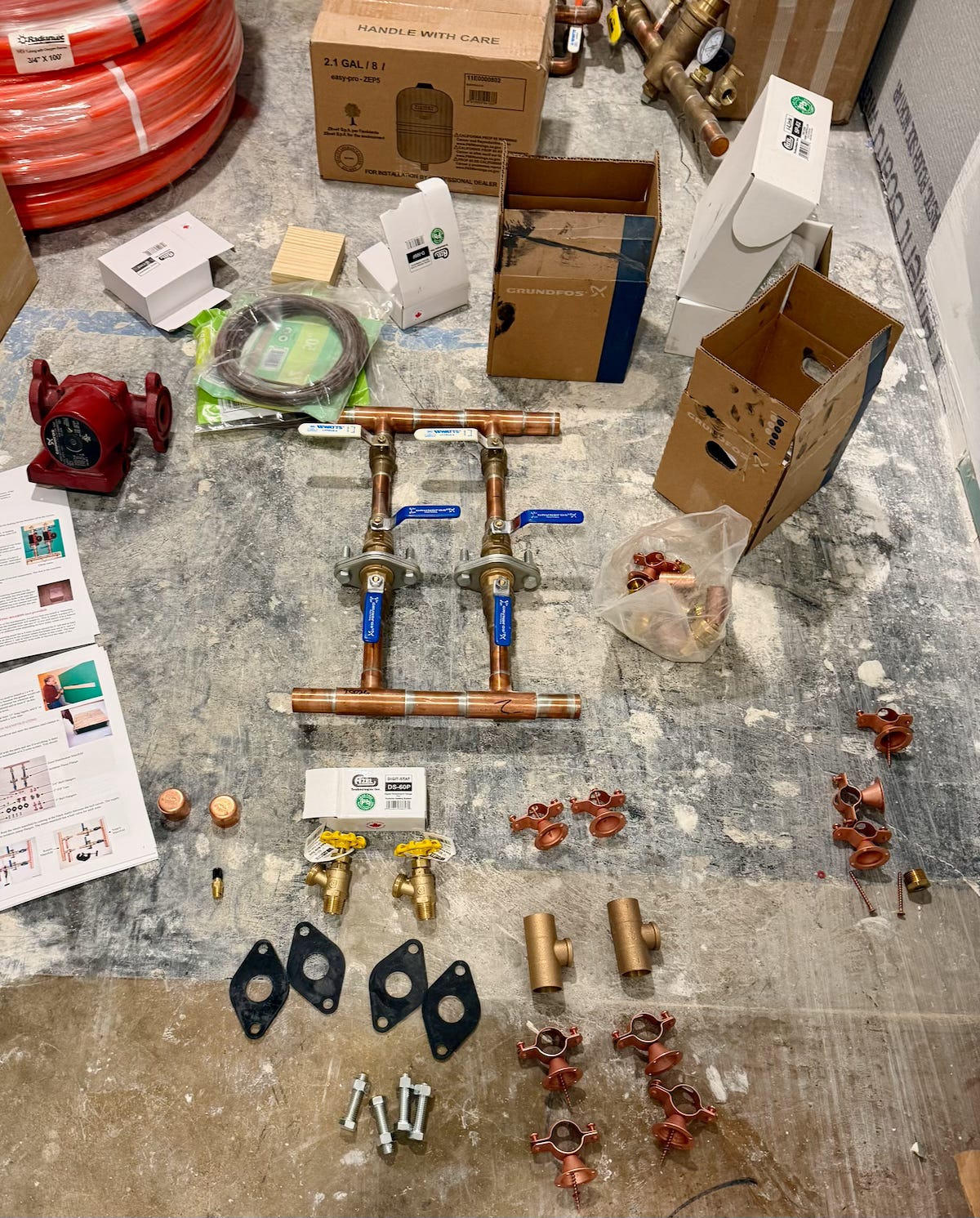
Despite feeling confident in my growing skills, I didn’t have a clear picture of how to assemble and arrange this stuff. It didn’t help that I hadn’t fully read Radiantec’s instructions, which I later discovered to be tremendously detailed. But I did know enough to understand it wasn’t a big job. I figured a plumber could take care of it in a day. The two biggest challenges would be laying things out properly and soldering copper pipes — the latter being a skill I had lacked proficiency in, but plumbers could do blindfolded.
So, I called my plumber to see what he’d charge to put it all together. I expected a quote of somewhere between $600 and $1,200.
He said he didn’t want to do it. “We don’t work on those kinds of systems,” he told me. I was a bit annoyed because, to me, all he needed to do was connect pipes. But, fair enough. He didn’t want to do it and that’s fine.
After searching around a bit, I found another plumber who said he’d take care of it. He was impressed with what I had done already, and though he was concerned the electric water boiler I had wouldn’t be powerful enough, he agreed to do the work. His quote? $6,400.
I was gobsmacked.
And frankly, offended. I’m not even sure how he came up with that figure. Was it based on hours? Ten hours at $640 an hour? Was it just the highest number he could think of that didn’t make him blush? Did his truck need a new transmission?
In retrospect, though, I’m kind of glad he gave me such an obscene quote. If it had been $1,200, for example, I might have reluctantly agreed. But $6,400? Fuck that.
That’s when I printed out Radiantec’s instruction sheets and realized the installation was actually even easier than I thought. They provided detailed layout guidance and while yes, there would be soldering, and no, I’m not good at soldering, I could practice. And really, how hard could it be?
Read the Instructions, Dummy
The instructions start by mounting the pre-built components. Having already brought the PEX tubing to a central location and installing a 4x4 sheet of ¾-inch plywood, it didn’t take long for me to line up and mount the pieces. A few screws, a few clamps, attach this pump to that pipe and that pipe to this pump and within about two hours I had the basic layout in place.
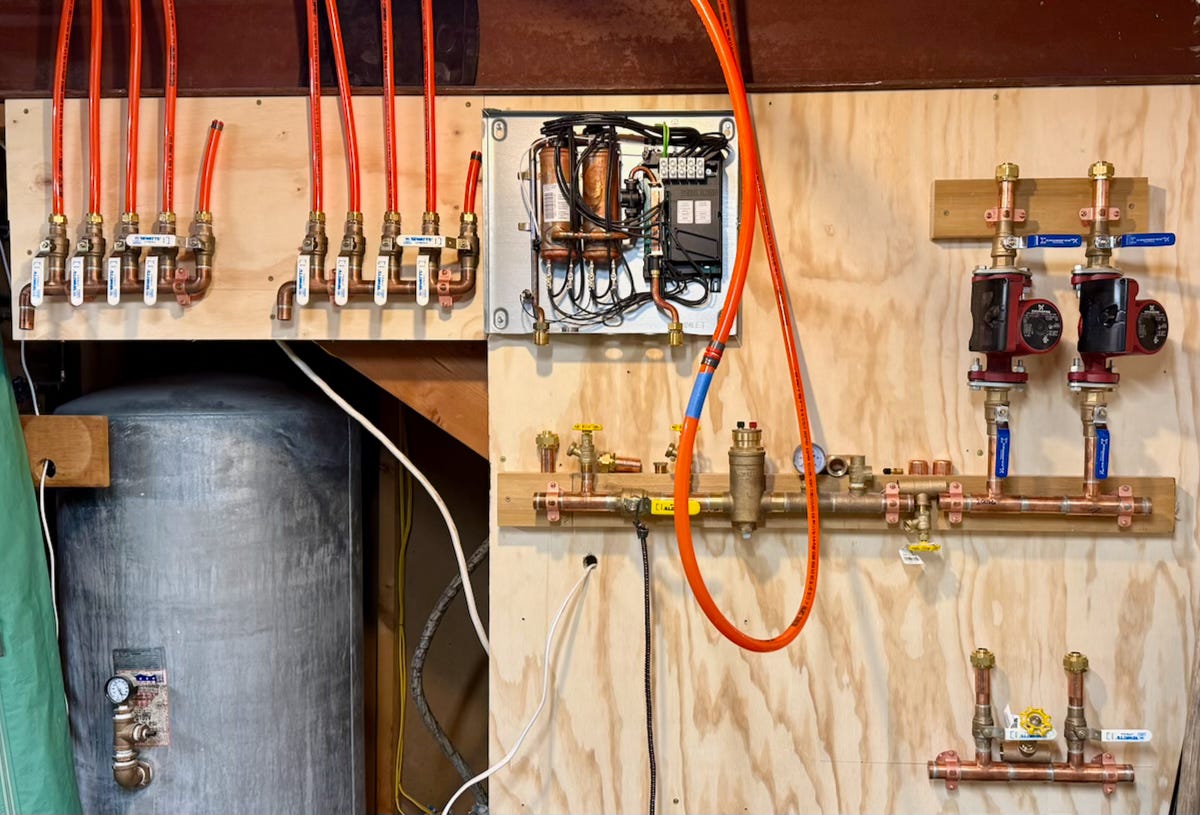
Next, I took the pieces off the wall and into my shop where I soldered them together. The first couple didn’t look so great, but then I felt like I was getting the hang of it. By the time I soldered my sixteenth and final joint, I thought I had done a pretty good job.
I took the pieces back to my basement, assembled it all together — including adding PEX fittings and tubes — and then fired up my air compressor so I could pressure-test the system.
The hissing sounds made it immediately clear my soldering skills were still very much a work in progress. I counted no fewer than five fittings that were leaking air. I got out my torch, flux, and solder, and went about redoing the joints in question.
In some cases, I was able to fix the leaky joints quite easily. In other cases, the flame heated the copper so much that the plastic PEX tubes melted and broke away. That meant I had to redo those fittings as well. Eventually, once I thought I had the leaks fixed, I re-tested with compressed air. More leaks.
This went on for several rounds until, eventually, in the wee hours of the early morning, I performed a test that maintained pressure. Finally I had an air- and (more importantly) water-tight system.


Under Pressure
Now it was time to fill it with water. My heart was racing. Sure, my tests said the system was tight, but once I added water, who was to say water wouldn’t start dripping from the ceiling or out from behind the walls?
I connected the hoses and opened the valves. Gushing, rushing, gurgling, burbling water sounds echoed through the tubes and the house. It sounded bad. Really bad. In my mind’s eye I could see water dripping through the freshly painted drywall ceiling and spilling out onto the floor. Thousands of dollars wasted. A setback that would take me months and thousands more dollars to repair. Maybe $6,400 would have been worth it. I expected my Apple Watch to tell me my heart was going into failure and to seek emergency help.
But, everything stayed dry. No leaks. No drips. No runs. No errors.1
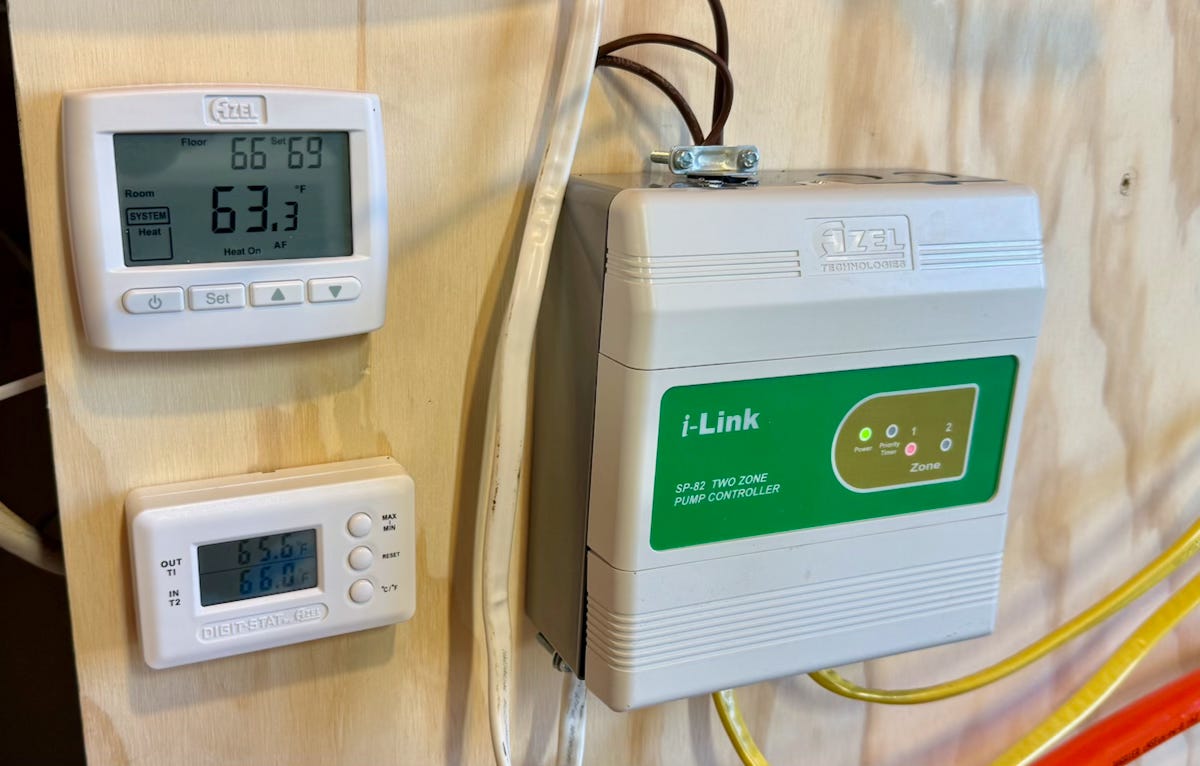
The next step was to install the electronics — the thermostats, the logic controller, the boiler, and the pumps. Radiantec had also provided detailed and clear instructions for most of this and within an hour, I had everything wired up.
I turned on the pumps and they started churning. Everything was great. The thermostats reported the floor temperature, the air temperature, and the water temperature on both sides of the boiler.
I watched and waited. The temperatures very slowly increased from about 65 degrees to 65.1 degrees. It seemed surprisingly incremental, but maybe that’s just how it works? Eventually, though, I realized the boiler wasn’t turning on. The temperature was increasing (ever so slightly) only because of the heat from the pumps themselves.
So now I needed to troubleshoot the boiler. Had I wired it wrong? I reviewed the instructions, turned to web searches, fired up AI chatbots, and called support lines. The boiler’s instructions were scant; the web searches were lacking; the AI advice was a mixed bag, and one of the support people I reached on the phone was a jackass who seemed to revel in confusing me with jargon.
Luckily, though, I also reached a super-helpful support tech at the company that makes the boiler. “It’s probably a bad flow sensor,” he told me, referring to a small plastic piece that monitors the flow of water through the boiler. “I’ll send you a replacement.”
I came to learn that the flow sensor is basically a little plastic pinwheel that sits in the boiler. When the pumps push water through the system, the pinwheel spins, which tells the boiler to fire up. Since the boiler wasn’t turning on, that indicated the sensor was failing.2
Meanwhile, I was impatient to get the boiler — and the whole system — working because the weather forecast called for single-digit temperatures and multiple feet of snow. So, I had the replacement sensor sent via next-day air (my god that’s expensive, though still less than $6,400). Then I watched YouTube videos on how to perform the necessary repair.
When the sensor arrived, I drained the water from the system, turned off power to the boiler, and began my flow sensor transplant operation.
It went surprisingly smoothly and within 10 minutes, I was refilling the system and preparing to flip on the breakers.
Like when I first filled the system with water, I once again found my heart racing. What if this didn’t solve the problem? What if I had really screwed something up? Maybe I bought the wrong boiler. Maybe I had plumbed the whole thing wrong. Should I have spent the $6,400 after all? Are the Browns doomed to suck for the rest of my life?3
But as soon as I restored power, I knew I had fixed it. I heard water flow through the boiler, which I now realized I hadn’t heard before. Then the boiler’s light flicked on. My mood lightened. The temperature sensors showed the water immediately heating…. 60, 65, 70, 80, 100. Within seconds, 135-degree water was flowing through the tubes. Within minutes, the radiators were warm to the touch. And in a few hours, the floors upstairs went from icy cold to toasty warm.
I was giddy. It worked. It really worked!
Maybe I should write myself a check for $6,400.
Points if you recognize that line from the 1980s Krylon spray paint ads featuring Johnny Bench.
Imagine if I had hired the plumber and this happened. I would have paid a ton for it not to have worked. And then I would have been charged even more to replace that part. Madness.
Wait, sorry, that’s a totally different worry.
Ha. "Legendary."
So Shedeur Sanders didn't show up with a soldering iron?