

One morning a few months ago, I awoke to this message on my phone:

It was from one of my neighbors who was on his way to the airport when he noticed the previous night’s storm had left some work for me to do.
I poured myself a cup of coffee, slipped on my boots, and trudged down to the end of the driveway.
As my neighbor correctly summarized, a tall twin-trunk oak tree had fallen over, with one trunk — roughly three feet in diameter — crushing our gates and completely blocking the driveway. The other similarly sized trunk had fallen away from the driveway alongside the road. Branches and debris littered the ground.
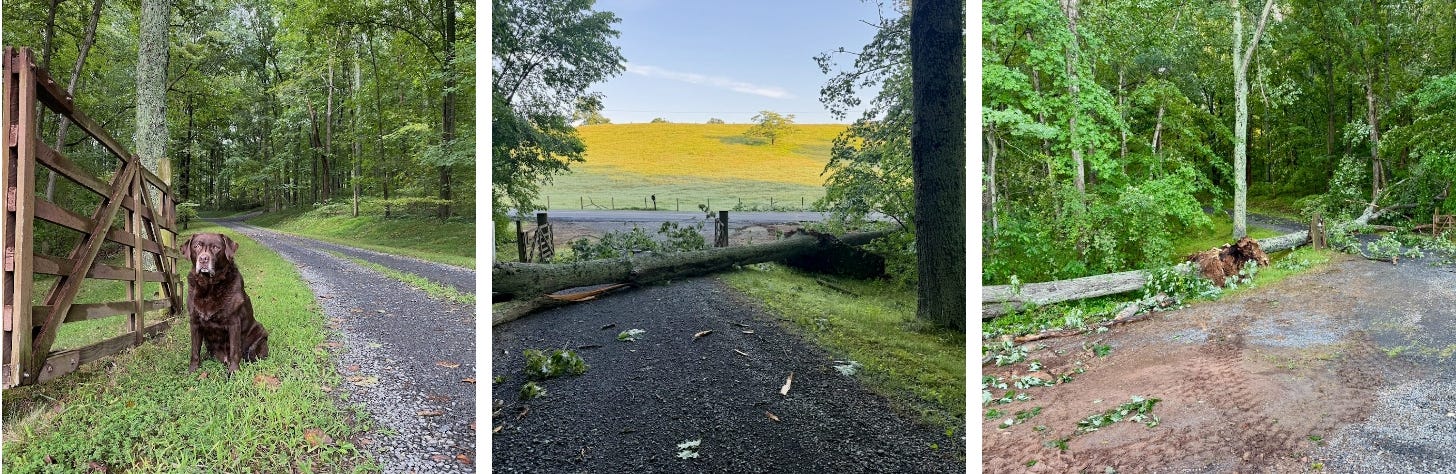
I imagine different people would react to this scene in different ways: despair, confusion, a reflex to start calling tree removal companies, or maybe even denial. For me, the reaction was “hell yeah!” I’ll just go get my tractor and a chainsaw and get to work.
Except my tractor was actually in the shop. And my chainsaw is a bit on the wee side for a job like this. But you go to war with the army you have, right? So I patiently worked the chainsaw through the thick trunk blocking the driveway. Once I got it into manageable sections, I used my 4x4 Gator, my truck, and some heavy-duty chains to drag the cut pieces out of the way. After about two hours, I had carved a path just big enough for my wife to squeeze her car through and head to work.
It was great progress, but there were still enormously heavy logs, downed branches, and the remains of the trunks, plus a couple of crushed gates to deal with. And thanks to a never-ending tractor repair and other demands on my time, the next several weeks saw very little progress. That prompted another text from my exceptionally kind and generous neighbor:

A front-end loader would be most helpful indeed, as would a second pair of hands. I rented a larger chainsaw from the nearby Home Depot, and with my neighbor’s tractor and help, we cleaned up most of the mess within just a couple of hours. We moved the sections I had cut up to my firewood pile, stacked branches for a wood chipper, and set aside two big logs — one 12 feet long and one 16 feet long, each about 30 inches in diameter — to mill into lumber.
I hadn’t been sure what I should do with the trunks, but whenever I looked at them, I couldn’t stomach just reducing them to firewood. I already had so much — something like 14 cords — that making more seemed not just unnecessary, but kind of ridiculous. Almost rude, actually. These big oak trunks were straight and thick and seemed to cry out for turning into lumber. I just didn’t know how to do that. Then I called a sawyer, and he said for $500 he could bring his mobile mill out and turn my trunks into usable slabs. That sealed the deal.
My initial thought was to use the forthcoming lumber to make my new gates, but I realized that the freshly milled wood would need time to air dry. It turns out the rule of thumb is roughly one year per inch of thickness, meaning it would be at least a year or two before I could use any of it.
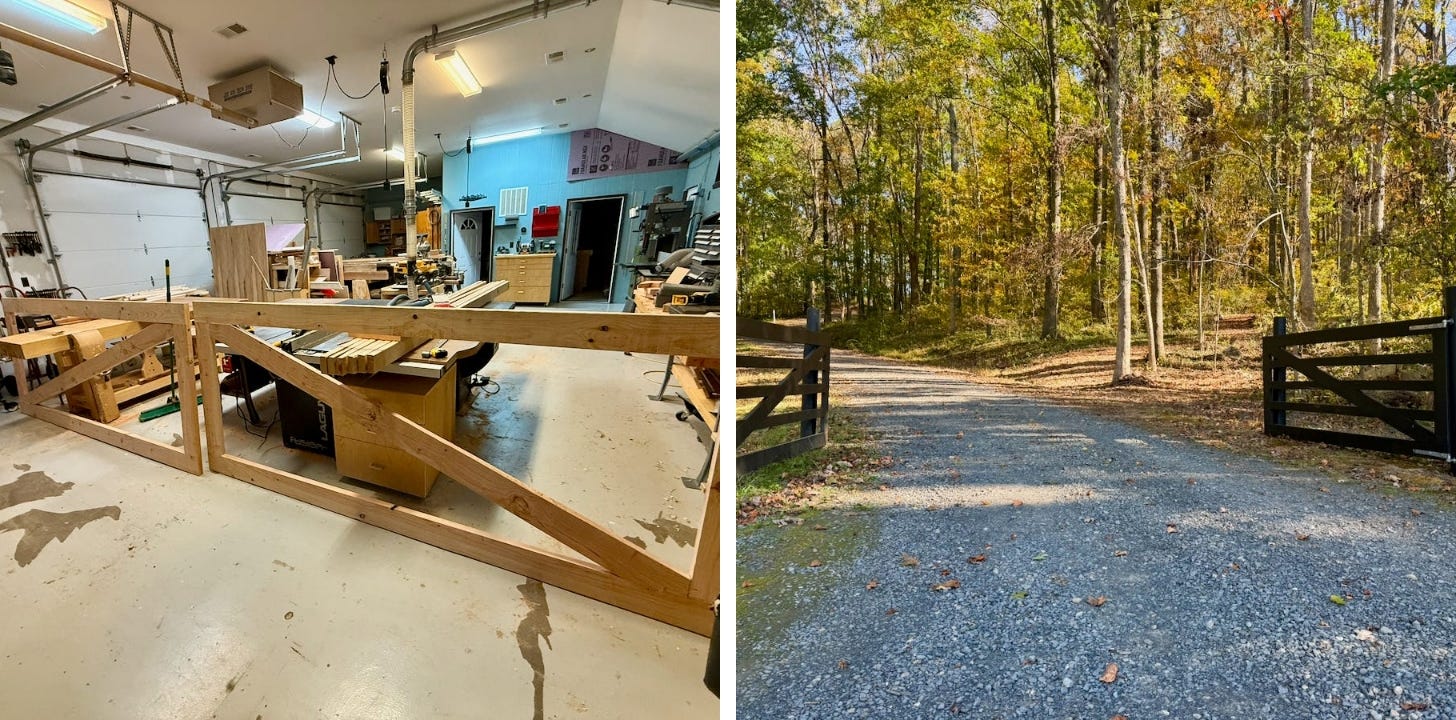
Instead, while I waited for my sawyer appointment, I bought some construction fir and quickly fabricated two replacement gates. I altered the design a bit to make them beefier. I made sure to set a diagonal brace from the lower hinge corner to the upper outside corner for support. Glue, pocket screws, and lag screws hold everything together. I cleaned up the original hardware, hung the gates on the old posts, and applied two coats of black exterior fence paint. Better than before.
When the mobile sawyer came, he pulled his mill alongside the two trunks. The machine is a bit of a marvel. It can grasp a multi-ton trunk with hydraulic claws and lift it onto a rail bed. Then a horizontal bandsaw slices through the trunk, creating planks of desired thickness. More hydraulic pistons and levers can rotate the trunk to change where the saw cuts next. Before long, each trunk had been sliced up into boards of varying width and thickness — and each far heavier than one might expect.
I piled some of the lumber into my truck and other slabs onto a makeshift “tractor trailer” and hauled them to a spot on my property where they can slowly dry for the next year or two. I stacked them on cement blocks with stickers — thin wooden spacers — between each layer to allow for airflow and painted the ends with a special sealant to help keep the plank ends from splitting.

Now, almost five months later, thanks in large part to my neighbor, the driveway is clear, the gates are back in place, and I have more firewood and lumber than I ever dreamed of.
So what will I make with all that lumber? I don’t know. Benches? Tables? Toothpicks? Stay tuned.