

When last we left my basement, I was pondering adding a reading nook opposite my built-in desk/bookshelf unit. My motivations were severalfold: to hide a small bulkhead, create a little more storage space, add a spot to relax, and zhuzh up my Zoom background.
I asked readers for ideas and among those suggested were a hot tub, a fainting couch, a place to store cleaning supplies, and a bookshelf with a humidor. All1 had their merits, but in the end I decided on a bench with under-seat drawer storage and an abutting bookshelf. What I was unsure about was whether I could come up with a design that I felt good about.
I had already looked to AI for some ideas, none of which felt right. But after pondering a bit, I gave ChatGPT a few new prompts and this time I liked what I was seeing:
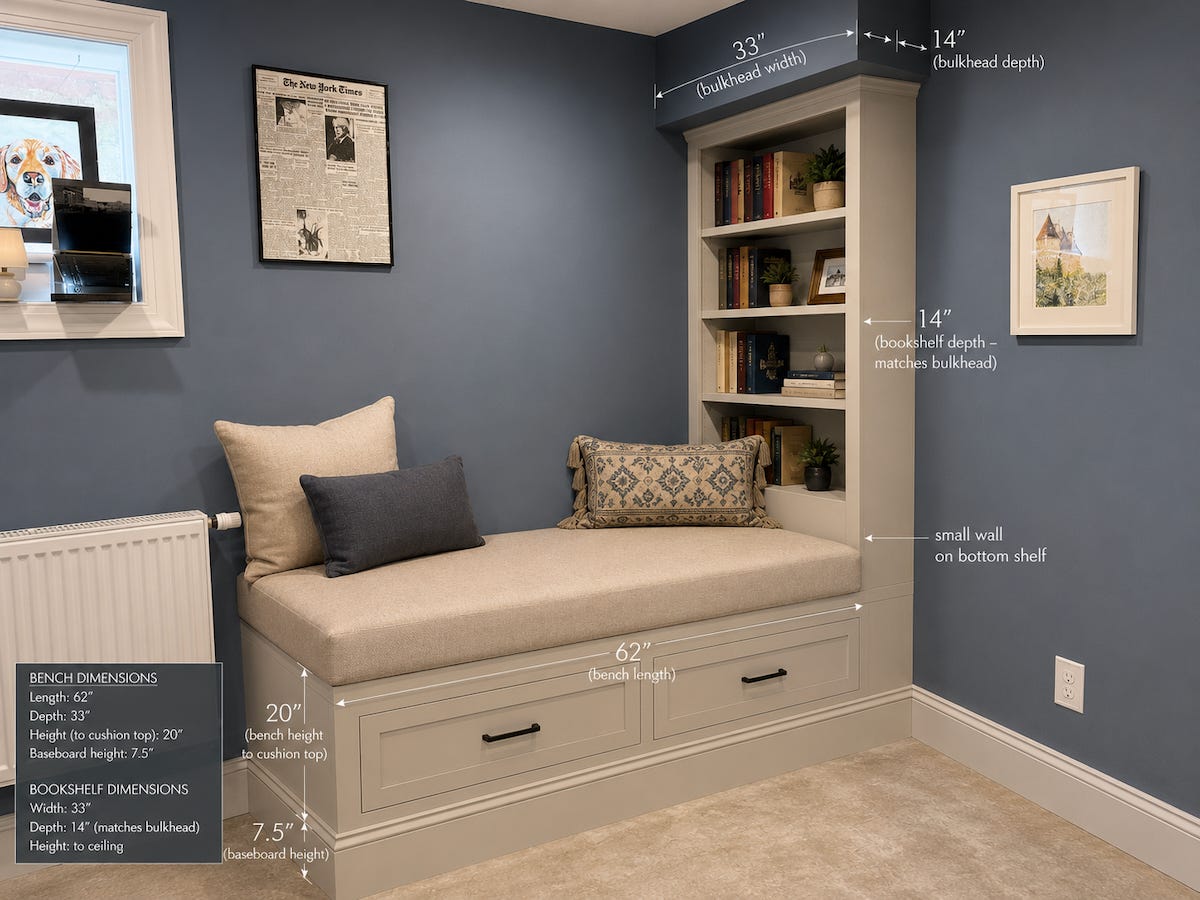
Yes, that would work. Maybe not that exactly, but it gave me the confidence to proceed.
I won’t go over every cut and glue-up. Frankly, the mechanics of the build aren’t especially interesting. Rather, I think it’s the forethought about how to avoid mistakes that is worth exploring.
Here’s what I mean: the bench would primarily be made out of plywood. Plywood is stable, strong, straight and flat. And it will stay that way. However, the edges are, well, plywood. It’s not what you want to see. So you need to think about where the edges are going to appear and how you’ll cover them up.
You also need to think about the stresses that will be exerted on the piece. This is a bench, so weight will push down from the top.
If you attach the top between the sides, say with pocket screws, you’ll hide the edge of the top, but now all the weight will bear down on those pocket screws. Eventually that will fail.
Alternatively, you could attach the top to the tops of the sides. That’s much, much stronger, but in this arrangement, the edges of the tops will show. Ugh.

Every decision has consequences for where you cut each piece and how the trim affects the final dimensions.
In other words, some of your first decisions will end up determining the final result and if you don’t think far enough ahead, you could end up with a nasty surprise later on.
Another example: Do I build the bench the full width and put the bookshelf on top, or do I build the bench and bookshelf side by side?
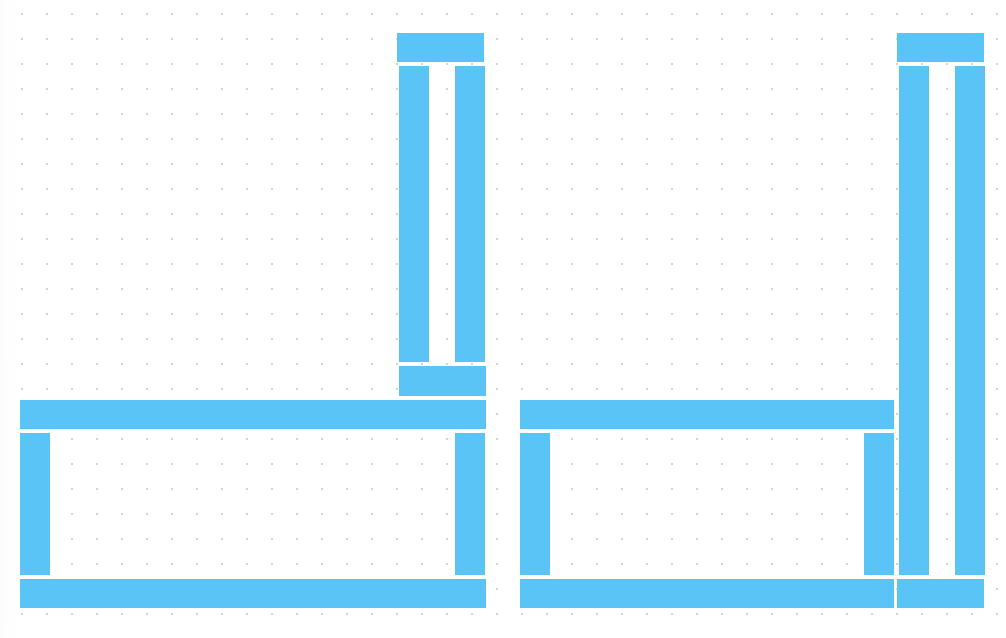
I decided to go with the side-by-side option, as I felt that would look better once the drawers and trim were in place; the drawers would be centered under the bench. Again, though, it’s a critical early decision that will determine the end result.
Once I worked out these decisions, I got started by building a base out of pressure-treated lumber. Since this will sit on a concrete slab, using PT will prevent moisture from wicking up and rotting the wood. Then I built the bench case with room for two deep drawers. The tall, shallow bookshelf will sit up against the wall under the bulkhead.
For the bookshelf, I made sure to include a small “wall” that would rise several inches above the bench itself.


In retrospect, I could have created some clever hidden or secret compartments in the bookshelf between the bench and the wall. Alas.
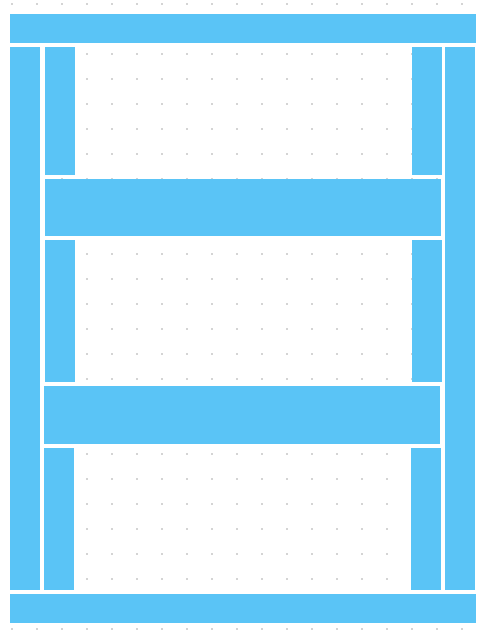
Once fabricated, I screwed the bench and bookcase to the studs and set about making the bookcase’s shelves. For this, I face-glued ¾-inch plywood to create 1-½-inch-thick shelves. I then attached 1x2 lumber to their front edges to hide the plywood edges.
Inside each side of the bookcase, I glued pieces of ¾-inch plywood to create the supports for the shelves. If you’re okay with shelves that will never move, this is an easy way to create perfectly even shelves with very little measuring or fuss.
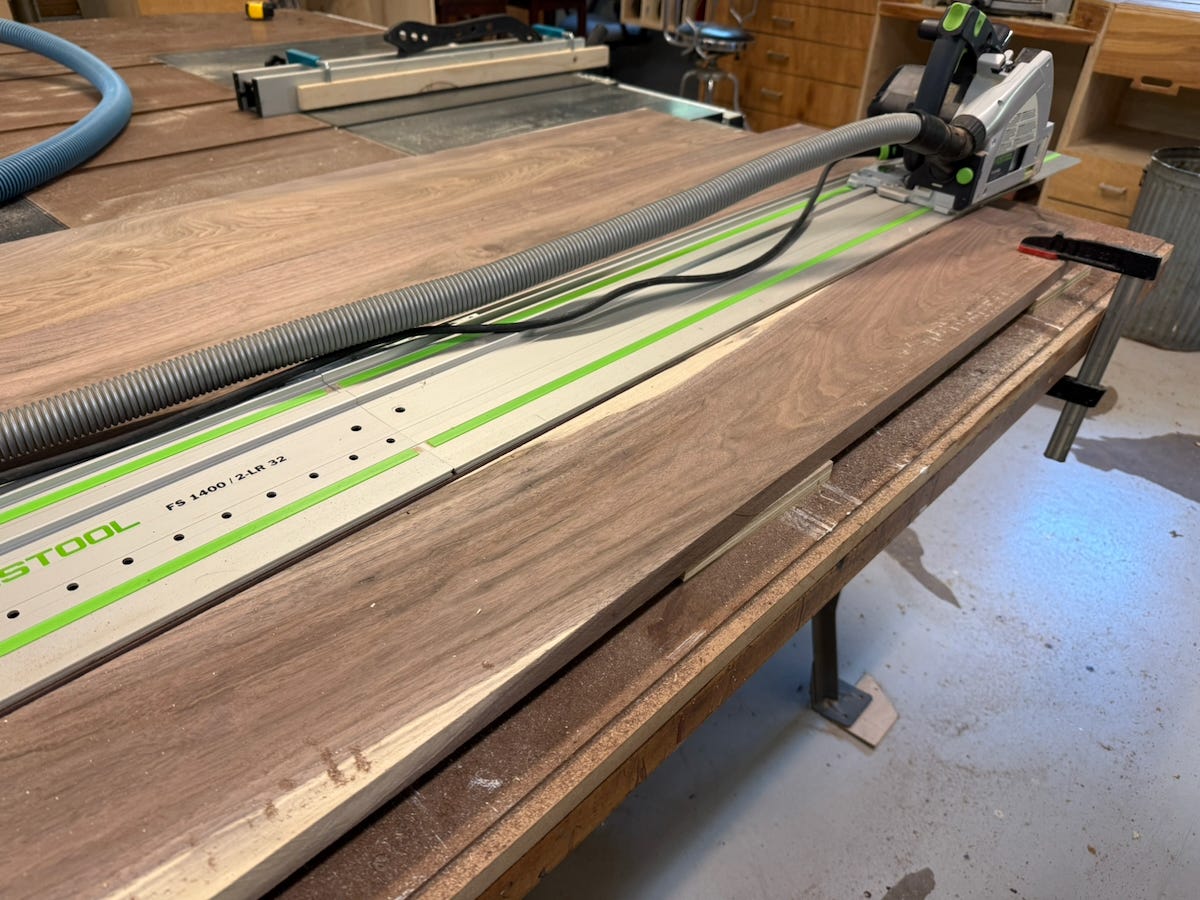
With the cases installed, it was time to make the bench top. I had hoped to use some walnut boards already in my shop. Unfortunately, I didn’t have the right sizes, so I headed to my local lumber supplier and bought what I needed. Once I cleaned them up with the planer, I needed to joint them to create nice tight edges. For this, I turned to a method I’ve come to really like: running the track saw down the seam.
To do this, I press the boards up alongside each other and lock them down. Then I set the track over the joint and run the saw through it. This creates a nearly perfect flush match and is so much easier than almost any other method I’ve yet tried.
After I cleaned up the boards, I glued them together, cut the top to rough size, and sanded it. Later, I’ll apply a hard wax finish that really brings out the natural luster of the wood. I really do love walnut. From the earthy smell of its sawdust to the chocolatey richness of its final appearance, it’s just a beautiful wood.
The more I thought about this bench, the more I realized the back couldn’t just be the painted drywall. It needed something behind it. Shiplap? Beadboard? Wainscoting?
Again, I turned to AI to render the different ideas. And I’m glad I did because it very quickly became clear that there was only one option that looked good: wainscoting.
Adding wainscoting was rather straightforward and similar to the other trim work I needed to do, including the crown moulding, the baseboards, and trim around the bench to hide those plywood edges. Within a couple of hours, I had all those pieces cut and in place.
At first, I thought I wanted the top of the wainscoting to be even with one of the shelves, but when I did a quick dry fit, I saw that it didn’t look right. I shortened the panels and the results were much more pleasing to me and my helpers.


Once I added trim and panels to the inside of the wainscoting and other parts of the unit, the whole thing really came together.
I still needed to right-size the walnut top, however, and that had me nervous because the bench wasn’t perfectly square. I didn’t want gaps where the bench would press against the back or side, and I wanted an even ¾-inch overhang. This was going to require careful scribing and thoughtful cutting.
To help ease my nerves and give me confidence to make the needed cuts, I got a large sheet of construction paper and made a template. I checked it several times and then transferred it to the top. After making the cuts (Apple Watch: Your heart rate is higher than normal), I brought the top in and confirmed it fit almost perfectly. Whew.
From there, it was just a matter of painting the unit and giving the walnut a coat of hard wax finish. Once the paint was dry, I attached the top with several screws. To allow for wood movement, I drilled slots through the plywood, giving the top room to expand and contract without splitting or buckling.
With that done, it was time to add two big, deep drawers. Using pine planks and half-blind dovetails, these came together quickly. Once I got the face frame painted and attached, it was all done.
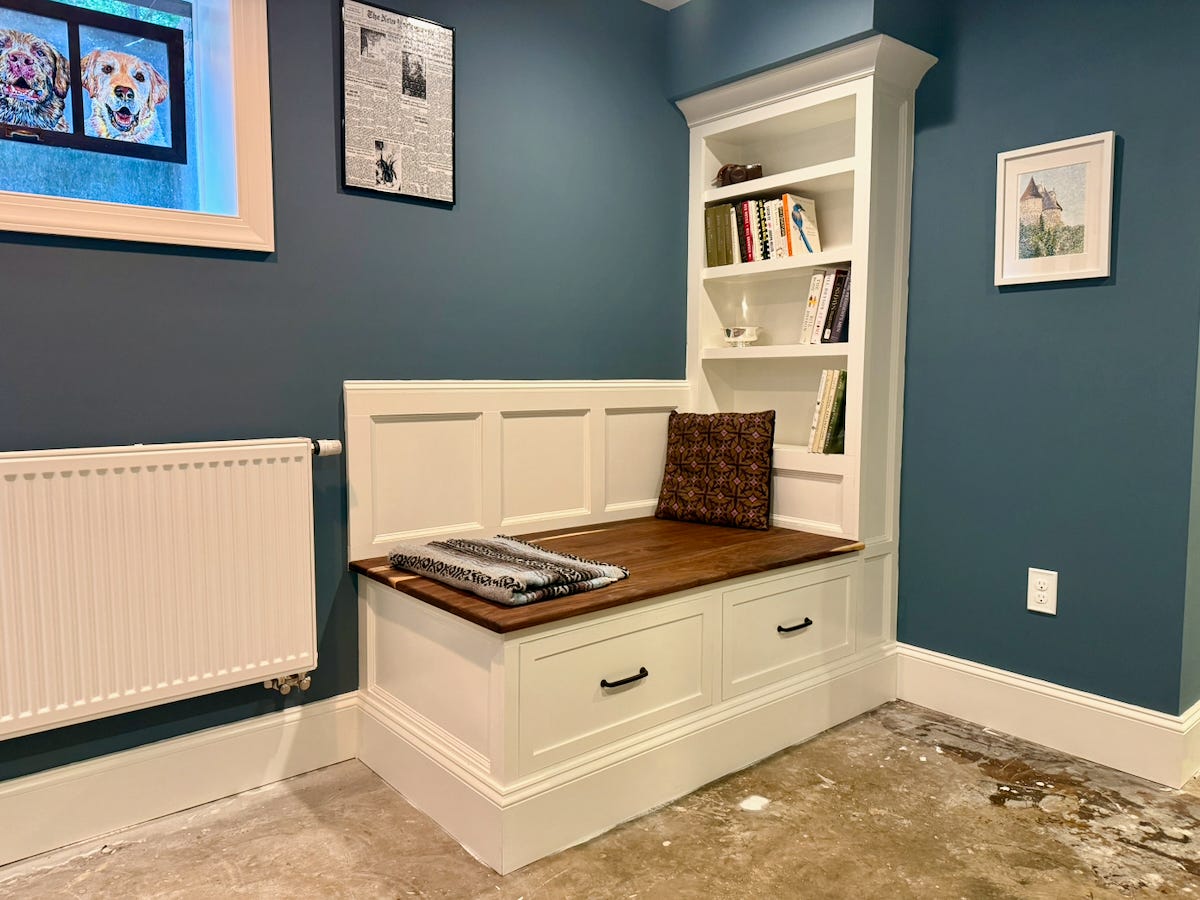
Are there some mistakes in this build? Of course there are. Three come immediately to mind. First, I made a completely unnecessary and idiotic cut that I had to “undo” by gluing in a large plug. Two, I should have measured the bookcase slightly differently to make the crown moulding more even under the bulkhead. And three, I should have given more thought to the thickness of the trim on the panel on the bookshelf compared to the wainscoting in order to keep them aligned.
But you know, I’ve come to accept that everything I make is flawed. That’s what makes it manmade. Hand of the artist, right?
Now it’s on to the next item on the list. Stay tuned.
Not all
Just beautiful.