

It was a little more than a year ago that I began my basement renovation. It started with bathroom demolition, quickly followed by framing new interior walls. Now, more than 12 months later, I’m finally putting drywall on all that framing.
Well, not me. I hired someone to do it because hanging drywall sucks and taping and mudding is an art unto itself. It’s also a nasty, dusty, dirty, painful job that I don’t want to do. And it’s incredibly easy to make a terrible mess of it. No thanks.
I ordered the materials — buckets of joint compound, dozens of sheets of drywall, screws, tape, and more — and got lucky that the delivery arrived between, rather than during, rain storms. The driver left everything in the driveway. It took me two hours to schlepp it all inside.
The guy I hired brought a helper, which was great because hanging drywall is not a one-person job. But it’s also not really a two-person job. The sheets are eight feet by four feet and weigh about 50 pounds apiece. Holding a sheet up to the ceiling really takes three or even four guys. So, I pitched in and helped hold up the sheets while the other two screwed them into the floor joists. I’m not going to lie — being tall is nice.


It took about two weeks for the guys to get all of the drywall screwed into place, taped, mudded, and sanded. The transformation was thrilling. Instead of see-through framing, I now had actual rooms.
Once I vacuumed up a thick blanket of dust from the sanding, I covered the drywall with primer and followed that up with a first coat of paint. Before applying a second coat, though, my drywall guy wanted to return to touch up any flaws and deal with any repairs that might be needed after I installed the lights. That gave me time to focus on adding trim to my built-in units.
The Built-In Look
One of the keys to giving the desk and entertainment center the true “built-in” look is adding trim and moulding, which visually ties them to the walls and ceiling. Now that the drywall was in place, I could finally take that step.
Each unit needed a piece of trim from the top of the unit to the ceiling, as well as crown moulding to refine that transition. The trim is simple enough, but crown moulding is (nearly) always an adventure due to its angled orientation.
I bought two 16-foot pieces of moulding. I cut the first piece for the desk and it fit perfectly. For the entertainment unit, which required three pieces to wrap around the unit, we’d need to cut several angled ends. For this, I was super careful. I made test cuts. I worked out all the angles and measurements. All I needed to do was cut a 16-foot piece of moulding down to “slightly longer than needed.” I measured, marked, and double-checked. I wasn’t going to screw this up.
I screwed it up. In a last-second attempt to minimize my waste, I accidentally cut it “slightly shorter than needed,” rendering an entire 16-foot piece of moulding useless. I just about lost it. Two-year-olds demonstrate more composure than I did at that moment. My dad, who was visiting and lending me a hand, shook his head solemnly and said, “it’s crown moulding.” What he meant, of course, is that I was always going to screw it up because crown moulding is carpentry voodoo. There’s Murphy’s Law and there’s the Crown Moulding Guarantee, as in “I guarantee you’re going to screw it up.”
As annoyed as I was, it was hardly the end of the world. The next day I bought another 16-foot piece and cut it correctly. Still salty about it, though the end result has debrined me a bit.


The List Keeps Getting Longer
The closer I get to finishing, the more it seems I have to do. I need to extend the window casings, install door jambs, in-wall speakers, lights, baseboards, base cap, trim, flooring, radiators, and more. Some of it I could start on right away, other bits would need to wait.
One thing I could get going on was the window casing. There was some casing already, but it didn’t cover the entire depth of the wall — only about half of it. To bring the casing out to be flush with the walls, I ripped 1x6 boards and shimmed them even with the existing casings, nailing them in place. I also added quarter-round trim between the glass and the casings. Then I filled all holes and seams with filler, sanded, and painted.
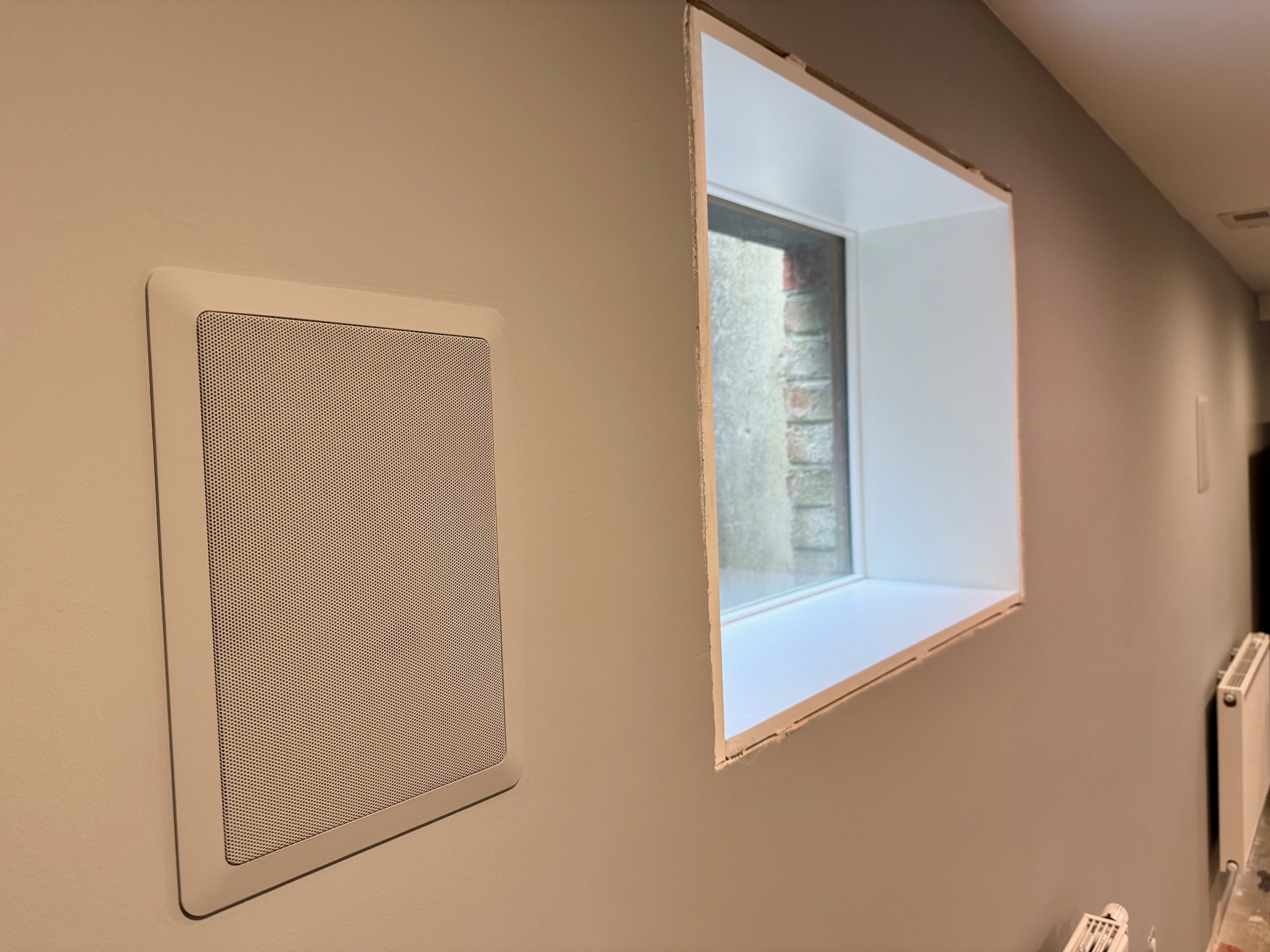
Another item on my list I could cross off was installing the in-wall speakers. All I needed to do was use a template to place and cut holes in the drywall in just the right place. I had previously laid speaker wire in the wall and marked locations on the floor. I just needed to make sure the holes I cut were between the studs and aligned with each other. The first speaker went in perfectly. So did the second — I thought. Then I stepped back to admire the results only to realize I mis-measured; the second speaker was about an inch too low.
It’s times like this that I wonder if I have lesions on my brain.
While I mentally flogged myself, my dad pointed out that the speaker trim gave me enough margin that I could shift the speaker up without needing to patch the hole and it would be properly aligned. For that, I was tremendously grateful.
To paint the speaker grills, which I had removed from the speakers, I opted against using a brush or roller, for fear of clogging the grill holes. Instead, I turned to a compressed-air gun a friend had given me some years ago but that I had never tried. I asked ChatGPT how to use it and then followed my AI overlord’s precise directions, which, I must admit, gave me perfect results.1
Let There Be Light
Several days later, my electrician returned to install new breakers and wire the various switches. I had already taken care of wiring all of the outlets (that’s pretty straightforward), but handling three- and four-way switches is something I still find confusing. Thanks to his fancy laser level and right-sized hole saws, he also cut out all the holes for my recessed lights, which I had been nervous about.
My nervousness stemmed from worrying that the holes wouldn’t be aligned properly, or that I’d cut into the wrong spot, or that the wires we had left in the ceilings wouldn’t be where we thought they were.
And to a certain degree, that last concern turned out to be true — several of the holes ended up on the other side of a joist from where the wire was. Had I done that, I’d be apoplectic. But, both the electrician and the drywall guy explained that this was actually normal. We’d just cut an access hole on the other side of the joist, cut a hole in the joist, thread the wire through, and then patch the access hole. And that’s exactly what we did. No big deal.
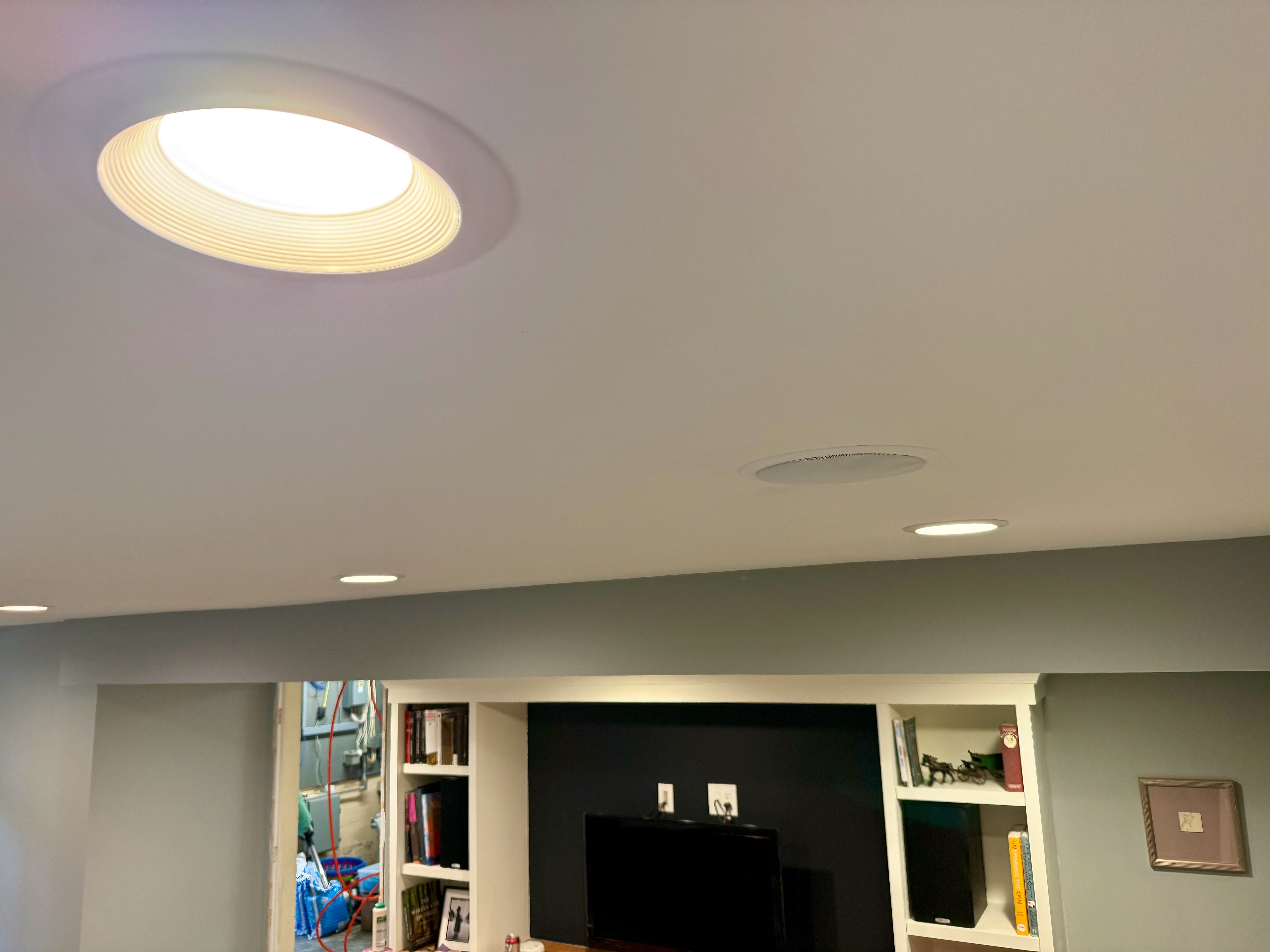
We had to do that several times and I came to see that cutting and patching drywall really is just part of the game. Sometimes you see end results and think it was all done so perfectly and so carefully. But in reality, what you’re often seeing — and this is true across life — are well-fixed patches to everyday fuckups.
I think that’s the secret not just to construction, but to daily living. Sure, you want to avoid making mistakes, but they are also inevitable. What really matters is how good you are at recovering from them.2
As the electrician wrapped up, the drywall guy was smoothing out his patches and I was wiring the last of the lights. Several days later, after the final coat of paint dried, I was starting to hang art.
It’s been a year of progress, but plenty still remains. I still have to hook up the heating, add baseboards and flooring, take care of the doors, and install trim. There’s furniture, too. And of course, there’s still the bathroom to do. But, it is progress and I am pleased.


One thing I wouldn’t have known to do was to thin the paint with about 10% water. ChatGPT also taught me what the various dials on the spray gun did. Helpful.
Note that I didn’t say “cover up.” It’s about fixing and recovering, not hiding or concealing.